Transformer 精 简 笔记
我想完整还原最原始论文里的流程,会完整过一遍,并尽可能带上数学理解
架构图
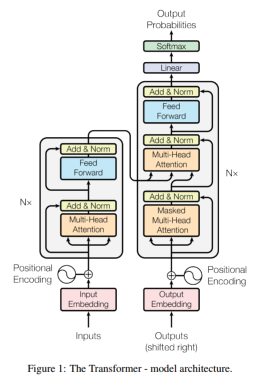
Tip
下面的例子中:
- \(d_{model}\) = 6
1. Encoder: Input Embedding 和位置编码
原论文使用的位置编码:
等会儿再来解释
最初输入是:
顺便把 decoder 的最初输入给说了
2. Encoder: Multi-Head Self-Attention
不同头选择输入矩阵\(X\)的每个token的向量内部的线性组合(token之间不杂交),通过不同的\(W_{Q_i}\) 和\(W_{K_i}\)和\(W_{V_i}\),得到\(Q_i\)和\(K_i\)和\(V_i\)
例如:
Note
\(Q, K\)的列数要一样(\(d_{k}\)),这样才能\(Q K^{\top}\)
\(Q, K, V\)的行数都是一样的,因为这样才能$softmax(\frac{Q K^{{\top}}}{\sqrt{d_{model}}}) V \(,当然这也是必然的,因为\)QKV\(是\)X$右乘权重矩阵得到的
然后把每个头的\(O_i = softmax(\frac{Q_i K_i^{{\top}}}{\sqrt{d_{model}}}) V_i\)直接拼起来
3. Encoder: Add & Norm
完整公式
- dropout = 0.1
先做残差相加:
Note
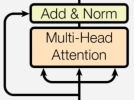
这个从 attention 前连到Add的箭头就是\(X_E\),是跳跃连接,残差
然后算LayerNorm,层归一化
算出每一行的均值和方差
\(\gamma, \epsilon都是可训练参数(是行向量)\) \(\gamma\) 用于缩放 \(\beta\) 用于平移
行与行之间不干扰,最后得到\(H_E\)
4. Encoder: Feed Forward
5. Encoder: 第二个 Add & Norm
最后得到的就是Encoder对每个token的最终理解,每一行是一个token
最后的输出矩阵\(Z_E \in \mathbb{R}^{n \times d_{model}}\)
6. Decoder: Output Embedding + Position
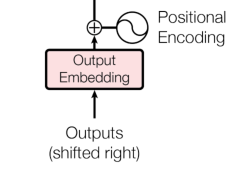
和输入向量的处理一样
7. Decoder: Masked Multi-Head Self-Attention
依旧多头,Mask矩阵会加到分数矩阵上
softmax之后\(-\infty\)就变成0了
然后把多头的自注意力输出concat起来得到\(M_D^{self}\)
8. Decoder: Add & Norm
9. Encoder-Decoder Cross-Attention
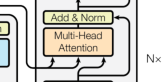
- \(Q\)来自Decoder
\(X_D'\)是Masked Self-Attention后的 decoder 表示
- \(K, V\)来自Encoder
分数矩阵:\(Q_D K_E^{T}\)
这里不需要mask,因为\(K_E\)是输入,\(Q_D\)是问题,都能看
然后每个头算出来一个\(A_{D, i}^{cross}\)
然后concat起来变成\(M_D^{cross}\)
10. Decoder: Add & Norm
11. Decoder: Feed Forward
12. Decoder: 再来一个 Add & Norm
13. Linear: 从 6 维变成 8 个词表分数
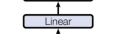
最初的词表Embedding矩阵\(E \in \mathbb{R^{n \times d_{model}}}\)
得到 logits,\(n_D\)行,代表输出有几个位置,\(n_{E+D}\)列,代表所有出现的词,就是词表的词数
14. Softmax
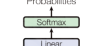
每行做softmax,输出的每个位置就能选了
计算损失
每一行能算一个\(\mathcal{L}_t\)
- \(p(y_t)\)就是这一行里最大的那个概率
然后算出所有行的平均损失\(\bar{\mathcal{L}}\)
然后反向传播,会更新的参数:
- Embedding
- 所有权重矩阵\(W_{Q,K,V}\)
- FFN的参数
- LayerNorm的\(\gamma, \beta\)
- ...